From Hungary – Best Practices that can Enhance Student Integration at Vilnius University
Reading size
Birželio 10–12 d. vyko tarptautinė „European First Year Experience“ 2026 konferencija, kurioje dalyvavo VU SA Integracijos proceso koordinatorius Mykolas Liaudanskas.
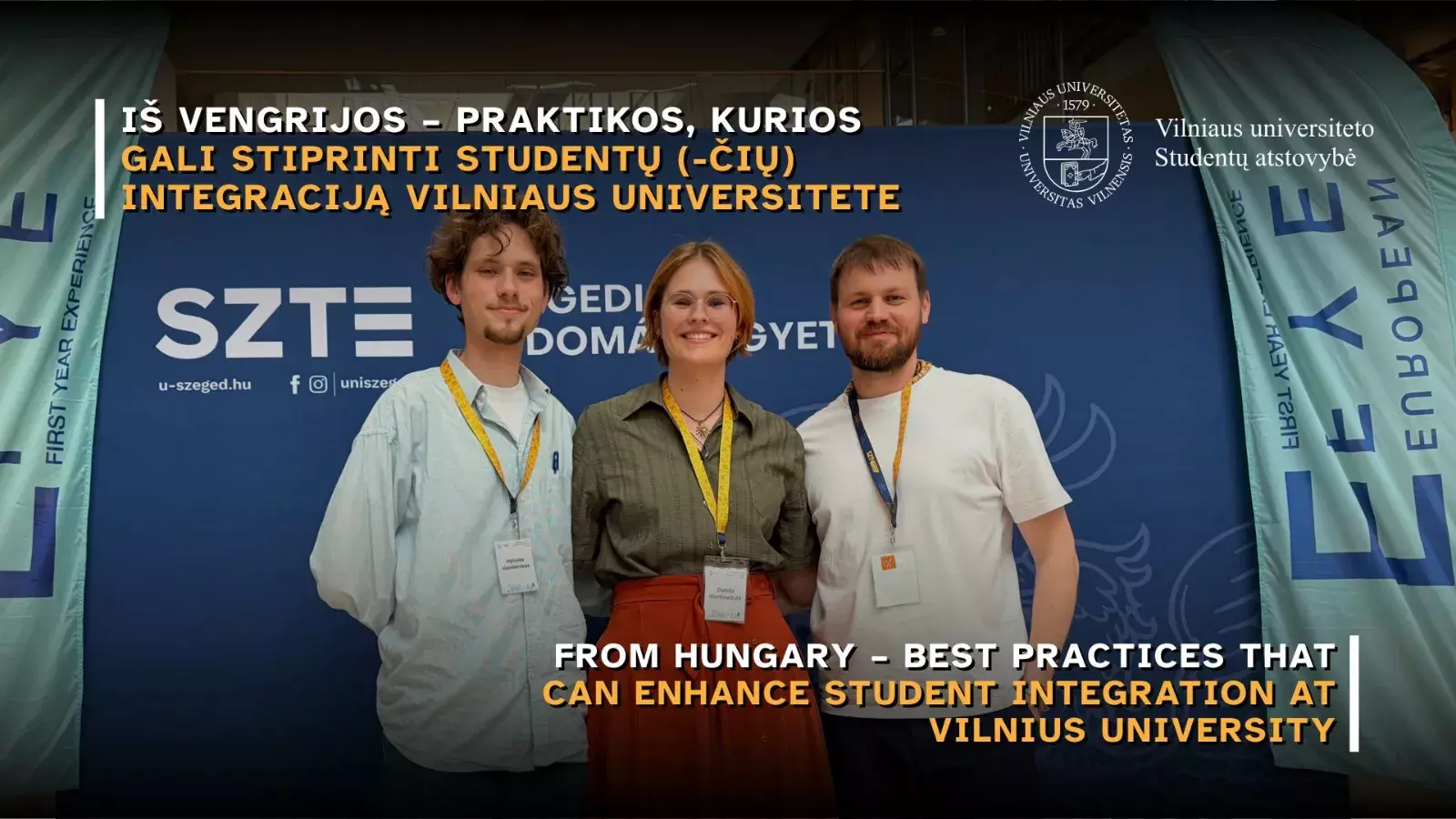
June 10–12, 2026, the international European First Year Experience (EFYE) 2026 Conference took place at the University of Szeged in Hungary. Among the participants was Mykolas Liaudanskas, Integration Process Coordinator at the Vilnius University Students’ Representation (VU SR).
Joining M. Liaudanskas at the conference were representatives of the Vilnius University Student Services and Career Office, Tadas Karosas and Guoda Martinaitytė.
Developing a Practical Tool for Universities
Together with partners from the University of Minho in Portugal, the Vilnius University representatives facilitated a workshop focused on analysing and comparing student integration initiatives across universities.
During the workshop, participants developed a structured framework that enables universities to systematically compare initiatives which may appear similar at first glance but often differ significantly in their goals, implementation, participant roles, and overall impact.
Mentorship programmes served as one example. While many universities offer them, their objectives, operational models, participant responsibilities, and the value they create can vary considerably.
Using a multi-level questioning framework, workshop participants were able not only to present their initiatives but also to discuss in detail how they function in practice, which challenges they address, and which elements could be adapted by other institutions.
“During the workshop, we realised that without a clear structure, conversations between universities often remain quite superficial. The tool we developed allowed us to analyse initiatives much more systematically and gain significantly deeper insights than we would through a regular discussion,” says M. Liaudanskas.
Integration Is the Responsibility of the Entire University
One of the key messages of the EFYE 2026 Conference was that student integration should not be viewed solely as a set of activities taking place during the first week at university.
In the conference’s keynote session, Professor Csilla Stéger presented findings from a long-term study conducted by the consulting firm PricewaterhouseCoopers, highlighting that students’ success is strongly influenced by their experiences during the first semester.
The topic of the first-year student experience was later explored from another perspective.
Michelle Morgan, Dean of Student Success at the University of East London, emphasised that the beginning of university studies is a significant period of transition and adaptation. Therefore, universities should avoid making assumptions about what students need.
According to Morgan, helping students establish themselves successfully at university requires not only showcasing positive examples but also creating opportunities to hear authentic student experiences—their challenges, uncertainties, and the ways they overcame them.
“The more presentations I attended, the more I realised that integration is not solely the responsibility of student unions, student support services, or individual staff members. It is the responsibility of the entire university. A student’s experience is shaped by lecturers, administrative staff, library specialists, mentors, and many other people they encounter during their first months of study,” says M. Liaudanskas.
Ideas That Could Be Adapted at Vilnius University
At universities in Belgium, first-year students attend dedicated seminars on learning at university. During these sessions, senior students share their experiences and help newcomers better understand what to expect during the transition to higher education.
“I really liked the idea of not only explaining how the university works but also demonstrating that asking for help is completely normal. The most successful students are not necessarily those who understand everything from day one, and uncertainty at the beginning of studies is a natural part of everyone’s experience,” says M. Liaudanskas.
At the University of Fribourg in Switzerland, a survey on student well-being is conducted at the beginning of the first semester. Based on students’ responses, they automatically receive recommendations for relevant university resources and support services.
“This approach not only collects valuable data but also enables an immediate response to students’ needs. If a student indicates that they are struggling academically or feeling lost, they immediately receive information about where to seek support. I believe a similar principle could be applied in our own integration research,” reflects M. Liaudanskas.
The Importance of Digitalised Processes
Another noteworthy practice was presented through the University of Amsterdam’s “Skills & Connect” programme. Alongside their academic studies, first-year students develop skills essential for university life, including well-being management, reflective learning, time management, public speaking, and the use of professional tools.
“What impressed me most was the idea that the university sees students not only as future professionals but also as individuals. It reinforced the importance of considering not only academic performance but also how students feel within the university environment,” says M. Liaudanskas.
The conference also highlighted a digital orientation programme developed at Maynooth University in Ireland. Delivered through a virtual learning environment, the course helps students familiarise themselves with university services, community life, and essential information even before their studies begin.
The course is continuously updated throughout the academic year, allowing students to use it well beyond their first weeks at university. In addition to information, it includes reflective activities that encourage deeper engagement with the study experience.
According to M. Liaudanskas, such a solution could help reduce the volume of information students receive during their first weeks and make it easier for them to revisit important information whenever needed.
Bringing Back More Than Just Ideas
Beyond the conference sessions and workshops, EFYE 2026 provided valuable opportunities to connect with university professionals from across Europe.
“I am bringing back much more than ideas related to student integration. I now have numerous contacts, examples, and insights that I would like to discuss both within the Students’ Representation and with various university departments. I hope this experience will benefit not only me but the wider university community as well,” says M. Liaudanskas.
European First Year Experience (EFYE) is one of Europe’s largest conferences dedicated to the first-year student experience. Each year, it brings together university staff and student representatives to share research, best practices, and initiatives that support students’ successful transition into higher education and strengthen both their academic and social integration.


