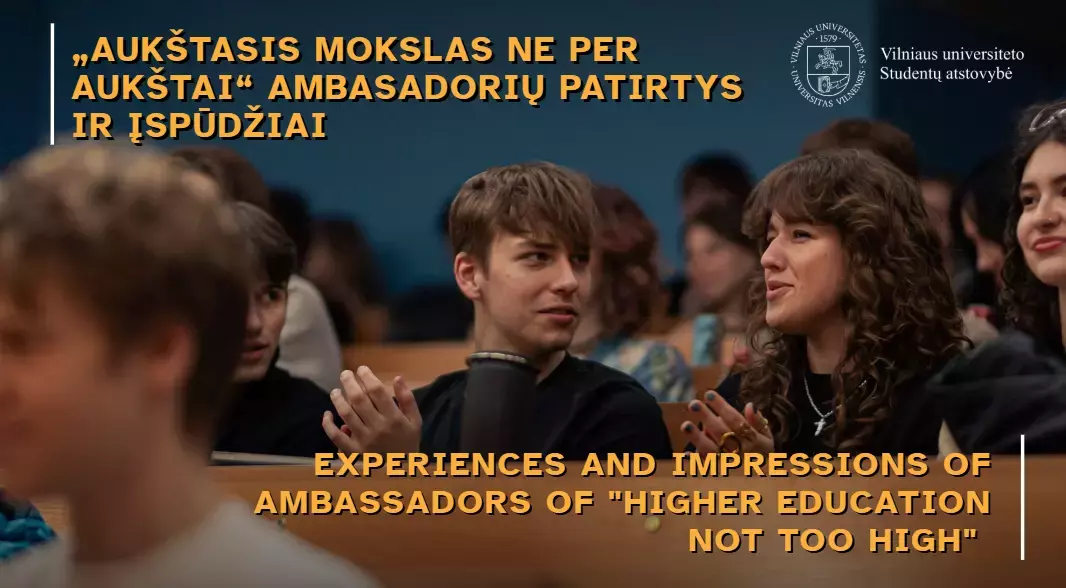
“Higher Education Is Not Out of Reach”: Ambassadors’ Experiences and Insights
E. Ubartas
Reading size
In November, VU SR organised student ambassador visits to schools across Lithuania as part of the project “Higher Education for Everyone – Without Boundaries”.
In November, as part of the project “Higher Education for Everyone – Without Boundaries”, the Vilnius University Students’ Representation (VU SR) organised visits by student ambassadors to general education schools across Lithuania. During these visits, ambassadors not only shared their own experiences and advice with prospective students, but also gained valuable insights into pupils’ motivation, access to information, and perceptions of higher education. We invite you to read the impressions they shared after returning from their visits:
What encouraged and inspired you to become an ambassador?
Kornelija: I chose to become an ambassador because the project’s message is close to my heart: higher education is for everyone, regardless of one’s social or financial background. I often heard stereotypes and fears expressed by people I knew, so when I learned about the VU SR initiative, I felt it was time to act and break those stereotypes.
Gabrielė: It is incredibly important to me that as many people as possible take an interest in the world, read books, and look beyond the boundaries of their immediate surroundings. Unfortunately, this is something better ensured in larger cities. So it mattered to me that children in the regions understand that higher education is within arm’s reach – a chance to develop, explore the world, and pursue their childhood dreams.
Jaroslav: After finishing school, I always wanted to be the kind of person who can share their experience and insight about studying at university. The opportunity to engage with pupils, help them understand the nuances of choosing a study programme, and encourage them to step more confidently into the world of higher education really appealed to me. It feels meaningful to contribute to young people’s decisions and to offer what I myself would have wanted to hear from students when I was still at school.
Anelija: I liked the idea behind the project. I truly believe that even a single conversation or a personal story can inspire pupils to apply to university. I also wanted to challenge myself in the role of an ambassador and gain a new kind of experience.
What doubts or fears most commonly appear in pupils’ minds? Are they related to finances, moving away from home, self-doubt – or something else entirely?
Kornelija: The most common thing I heard from pupils was: university is too difficult.
Gabrielė: Many pupils are afraid of the big city – that they won’t manage, will feel lost, will lose touch with old friends and fail to make new ones. They also worry about not being admitted to a state-funded place and not being able to afford tuition fees.
Jaroslav: The most frequent theme was a lack of self-confidence – the fear of not being admitted, not coping, or not being “good enough”. Finances were also a major concern: whether studies would be too expensive or whether they would be eligible for support.
Guoda: Arguably the biggest fear is the unknown. Study choices, living in another city, finances, or even the simplest day-to-day matters can feel overwhelming. I hope that through our discussion pupils realised that the unknown is not something to fear but, in fact, something worth diving into wholeheartedly.
Anelija: I noticed that many pupils are afraid they won’t find like-minded people in a larger city and will end up feeling alone. They worry that university will be more challenging than school or that they’ll regret their choice of programme.
What did you realise about the dissemination and accessibility of information in the regions? Do pupils know enough about social scholarships, targeted payments, or support for students with disabilities?
Guoda: This project made me realise how important it is to hear several perspectives on higher education and its significance – both for one’s career and personal development. Teachers’ perspectives differ somewhat from ours as students, whose experience may feel more relatable and easier for pupils to grasp. I’m glad if I encouraged even one listener to pursue their goals in higher education.
Gabrielė: Information dissemination in the regions is rather poor; how much a pupil knows largely depends on how much they actively seek out. Their knowledge about funding and scholarships is very limited.
Jaroslav: There is a clear lack of accessible, straightforward information in the regions. Many pupils were unaware of social scholarships, targeted payments, support for students with disabilities, or even the availability of state-funded places.
Anelija: Pupils seemed to have heard about most things, but only in fragments, and they often mixed up different concepts. They knew scholarships existed but had no real idea what types there were, how to apply, or whether any forms needed to be submitted.
Kornelija: I would say pupils either knew nothing at all about financial support or had heard of it but didn’t understand who it was intended for. So we devoted a significant amount of time to financial matters. They were particularly interested in the 450th Anniversary Scholarship and in learning how to apply for a student loan – something many had never even heard of.
What should a pupil do now if they heard your talk, felt hopeful, but still hesitates? What should be the first concrete step?
Gabrielė: I think the first step should be to contact their school’s careers counsellor, and if they don’t get the answers they need, then the relevant department at the university they’re thinking of applying to.
Jaroslav: Step one – talk to someone: a careers adviser, a current student, or even me (as an ambassador) via social media. Talking helps clear your thoughts and understand that doubt is normal. After that – look into programmes, check entry requirements, and explore opportunities for financial support.
Anelija: As they’ve already heard where to look for information, they should start browsing university websites, exploring study programmes, choosing what appeals to them, and feeling even more motivated to finish school.
Kornelija: Definitely – reach out to VU SR or programme coordinators. Nothing is more inspiring than young people who remember exactly what it felt like to doubt their study choices and who can offer advice or first-hand stories about the challenges ahead.
Do you think initiatives like this should become a systemic part of education? Why?
Kornelija: Yes, I believe initiatives like this are essential, because pupils aren’t always able to figure things out on their own and lack exposure to real-life experiences. Direct contact helps them realise they are not alone on this journey.
Jaroslav: Absolutely. These initiatives create a genuine dialogue between universities and schools. Pupils receive not only theoretical information but also a living, authentic insight into university life. Student ambassadors can share what no website ever could – the real atmosphere, daily experience, and emotions.
Gabrielė: I think this should be part of the education system, as such initiatives raise the level of education not only in the regions but across Lithuania. They also help reduce shortages in various professions both in the regions and in cities, improving the country’s overall quality of life.
Anelija: I truly believe it could become part of the education system – not only in the regions but also in bigger cities. As one pupil said, such presentations provide far more practical advice and real stories than what they typically hear in careers lessons.
Guoda: Yes, yes, and again yes! These initiatives encourage everyone to challenge themselves – students return to school for a lesson (though not as pupils this time), and pupils gain a push to explore and dare to dream. After all, higher education is not all that high up.
What feedback did you receive from the teachers and school administrators who welcomed you?
Guoda: It was lovely to hear that both the project idea and the presentation itself were interesting not only for pupils but also for teachers.
Anelija: They also took part, asked questions, and sought clarification on various details. I heard very positive feedback – they found it genuinely useful.
Jaroslav: I received very warm responses. Teachers highlighted how valuable it is when a university is represented by students themselves; pupils react to them more openly and feel more comfortable asking questions they might not ask official representatives. They said such visits help pupils better understand what studying is really like and motivate them to think seriously about their future..
Kornelija: Teachers were delighted that young and energetic presenters came – people who still remember the admissions journey and were able to connect with pupils, understand their fears and doubts, and share quite complex information in an accessible way.
What did you personally take away from this experience?
Anelija: I really enjoyed giving the presentation and answering all the questions. I felt like an older sister sharing her experience with younger ones. It’s a great feeling to see pupils genuinely interested afterwards. It was also another valuable experience in public speaking and leading discussions.
Kornelija: My public speaking skills definitely improved. I also revisited my own experiences and realised that all the fears I once had were simply fear of the unknown. I was reminded how important it is to disseminate information and to be a role model for those around us.
Gabrielė: I realised how important it is to talk about higher education to as many pupils and non-students as possible – to show them that it is not as unattainable as many believe. Universities and colleges welcome everyone – including those with disabilities or mental health challenges. Everyone can study meaningfully, and institutions will do their best to ensure students have all the necessary support.
Jaroslav: I took away a simple but powerful thought – even a short conversation can change someone’s direction.
We thank all the ambassadors for sharing their thoughts and experiences. We believe that this initiative has been meaningful not only for the pupils, but also for the ambassadors themselves.


