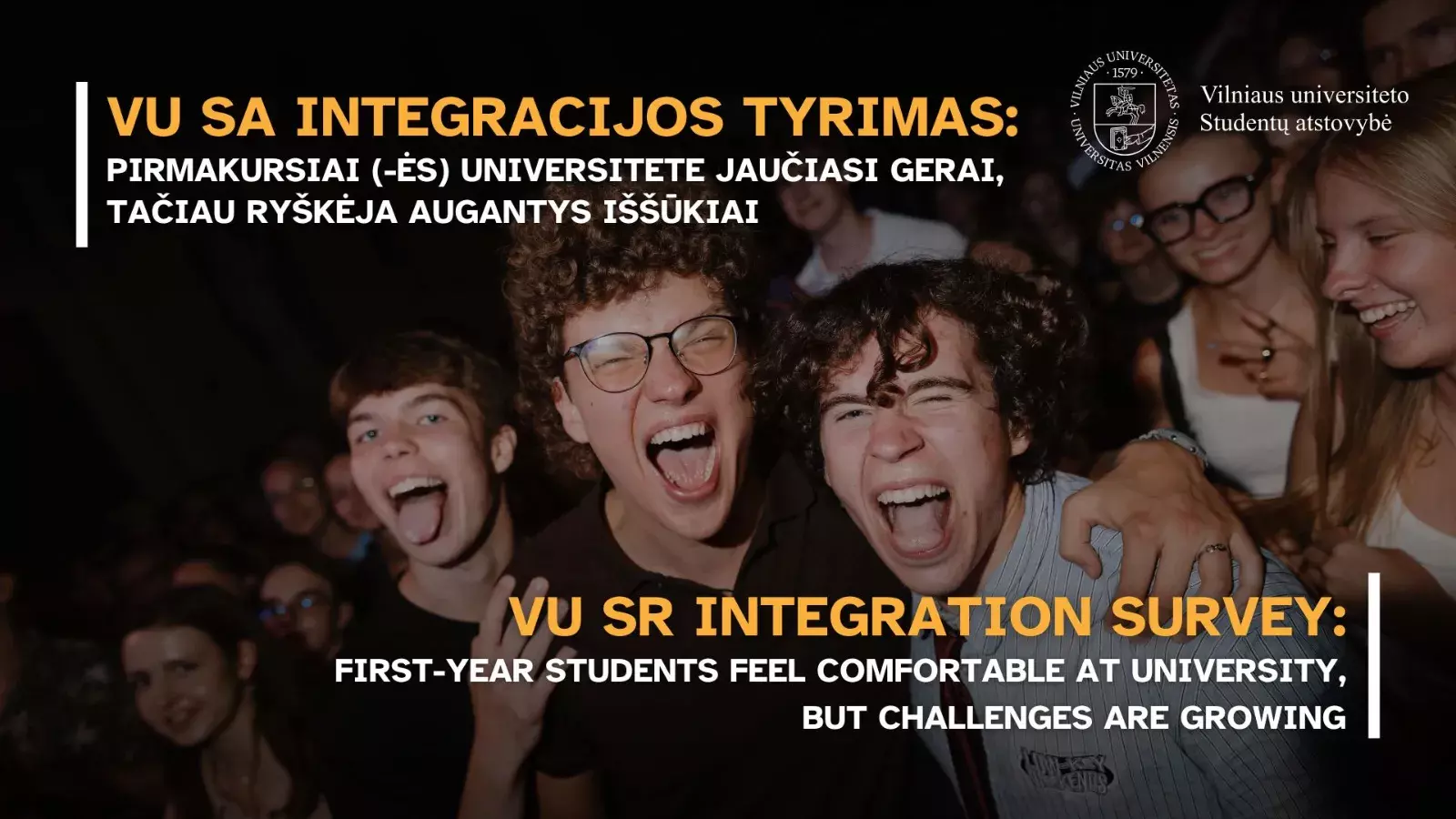
Integration survey: first-year students feel comfortable at university, but challanges are growing
Ugnius Bagdonavičius
Reading size
We are sharing the results and insights from the first part of the integration survey.
For eight years, the Vilnius University Students’ Representation (VU SR) has been conducting a survey on first-year students’ integration into Vilnius University. The aim of the study is to assess the success of integration processes and ensure their improvement in the future. The study is carried out twice a year to evaluate students’ integration during their first year of studies. The survey was conducted over one month and was completed by 1,912 first-year students. We are sharing the results and insights from the first part of the study.
First-year students feel good at the university, but the study reveals growing challenges
The first part of the 2025 first-year students’ integration study presents an overall positive picture – most first-year students successfully adapt to the university environment and feel well. Two-thirds of students rate their well-being positively.
Strong connection with course students
One of the most prominent findings of the study is the favorable evaluation of the study atmosphere. The majority of students indicate that friendliness, cooperation, and support prevail in their academic environment. This suggests that the process of social integration is progressing successfully.
Daily interaction with fellow students remains a key factor helping first-year students feel safer and more confident in the new environment. Such micro-communities become an important element in ensuring emotional well-being at the beginning of studies.
Academic information reaches students effectively
The study also reveals that essential academic information reaches students fairly quickly and smoothly. Most first-year students state that they are familiar with their study program, courses, and principles of academic ethics.
This indicates that the university succeeds in providing fundamental academic knowledge at the start of studies – students understand what is expected of them and what the core academic rules are.
The mentor program – a crucial link in successful integration
The mentor program continues to play an important role in integration. Respondents frequently mention curators as one of the primary sources of support, both for academic matters and for navigating the study environment.
In addition to informational assistance, emotional support is also highly valued – first-year students emphasize curators’ accessibility, quick responses, and encouragement during integration. This positions the program as one of the most significant elements of successful integration.
Growing challenges: what do the data show?
Although the overall picture remains positive, the study highlights important trends signaling changes in first-year students’ experiences. A total of 67% of students feel good or very good at the university. This still represents a clear majority; however, another important detail emerges – a growing share of neutral evaluations.
More than a quarter of students report feeling “neither good nor bad.” While this position does not necessarily indicate a negative experience, it may reflect uncertainty or adaptation difficulties. This trend points not to a sharp decline in well-being, but rather to greater caution in how students assess their experience.
Learning difficulties – an almost universal experience
Most first-year students report encountering academic challenges. The most frequently mentioned difficulties include time management, understanding information, and maintaining motivation.
These results reflect a typical transitional period – the pace of studies, demands for independence, and the assessment system represent a significant change for many students after school. Importantly, students most often address these difficulties independently or rely on their immediate environment.
A considerable number of students indicate that they lack a clear understanding of university decision-making processes, opportunities for individualized studies, and certain available services. This suggests that while information reaches students, it is not always sufficiently clear, practical, or easy to apply.
Outcome: changes in student experiences
The first part of the integration study reveals a noteworthy and widely discussed trend. First-year students are generally integrating successfully, feeling fairly well, and finding support within their immediate environment. However, growing uncertainty is also evident – more neutral evaluations, frequent academic difficulties, and communication gaps.
This signals a meaningful shift in student experiences. The study results can serve as an important foundation for future decisions – strengthening emotional well-being initiatives, explaining processes more consistently, and improving communication.
The overall picture remains clear: most first-year students feel good at the university, but their adaptation path is becoming increasingly complex and requires greater systemic attention.
What does this mean? VU SR recommendations for improving integration and the study process
These recommendations aim to enhance first-year students’ integration experience, increase information accessibility, promote social and financial support, and ensure a smoother study process:
Communicate earlier and more consistently about individualized study options.
Increase awareness of services provided by the university and their benefits.
Orient integration activities toward practical aspects of the study process, with greater focus on learning in higher education.
Organize reintegration events for first-year students.
Strengthen students’ knowledge of resilience and civil safety.
Emphasize the benefits of integration events and improve their communication strategically.
Considering the study results, it is advisable to pay greater attention to first-year master’s students, whose engagement in integration activities is lower. It is recommended to communicate more clearly the specific benefits integration events provide to master’s students, encourage group activities, regular cohort meetings, and informal interaction, which over time strengthen both academic and social integration. Such meetings could be initiated by mentors, VU SR teams within departments, or faculty administrations.


