
Life in a VU Dormitory: What You Need to Know Before Moving In
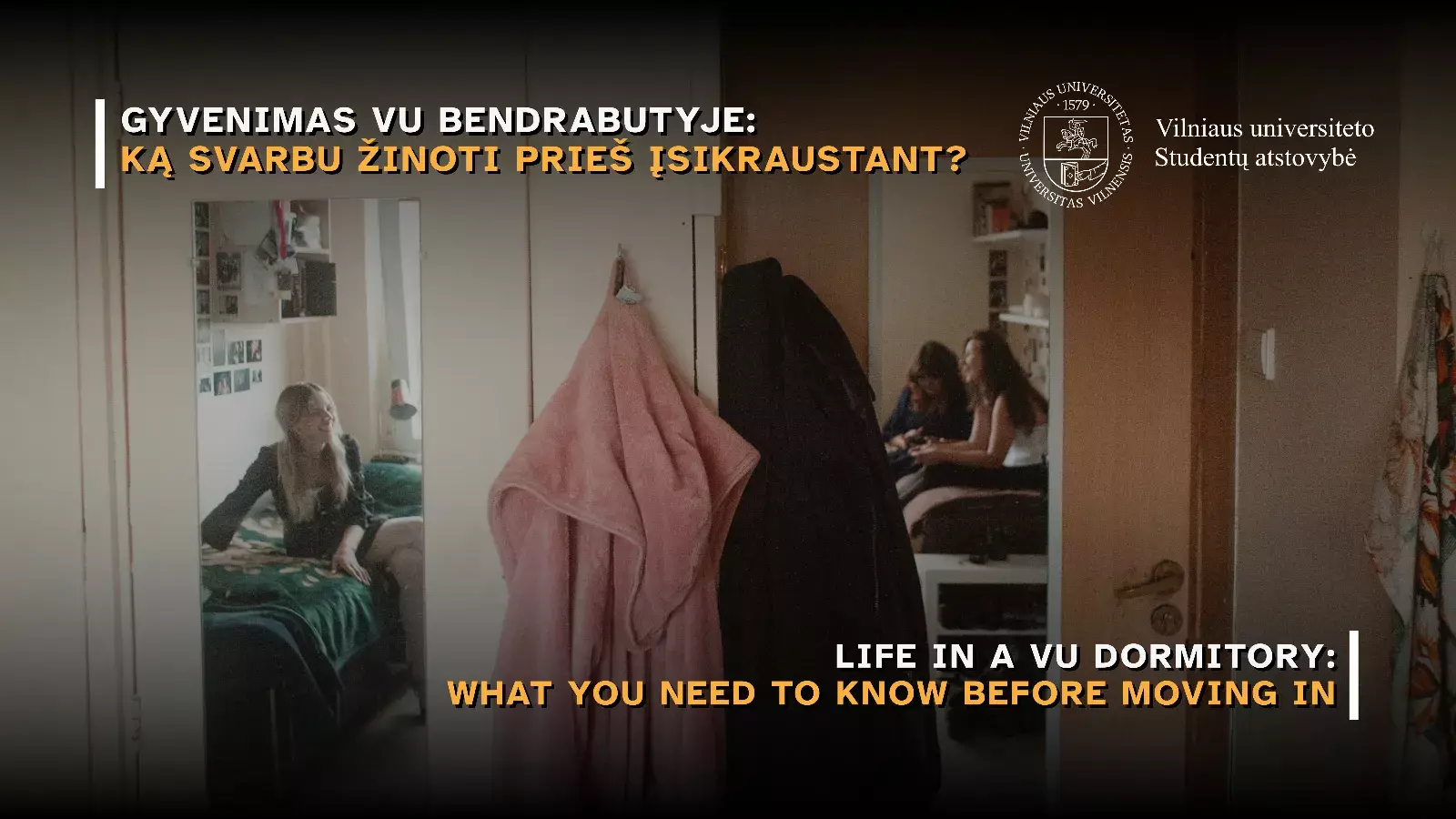
Photo by Ugnius Bagdonavičius
Reading size
Starting university often means more than new lecture halls, coursemates, and first classes – for many, it is also their first experience of living independently.
Starting university often means more than new lecture halls, coursemates, and first classes – for many, it is also their first experience of living independently. Moving into a dormitory can raise more questions than answers: can I live with a friend, what will I find in my room, do I need to bring a fridge, and what should I do if I do not get along with my roommate?
Vilnius University Faculty of Medicine student Roberta Kirkliauskaitė and Artūras Šaltis, administrator of the five-storey dormitory complex, discussed life in Vilnius University dormitories on the START FM radio show Tiesiogiai iš VU SA. They shared the most important information about the allocation of dormitory places, moving in, everyday life, and why a dormitory can become much more than simply a place to sleep.
How are dormitory places allocated?
Vilnius University dormitories are divided into several dormitory campuses. Students may be accommodated in Saulėtekis, Didlaukis, M. K. Čiurlionio Street, or other dormitories, depending on their faculty and the number of available places at each location. If there are not enough places in one dormitory campus for all students from a particular faculty, some may be accommodated elsewhere.
According to A. Šaltis, it is important to understand that when submitting an application, a student is applying for a place in a dormitory, not for a specific room or floor. Submitting an application earlier also does not automatically mean that a student will receive a better room.
“You have to understand that you are being allocated a place, not a specific room. It is not the case that whoever applies first gets something first or gets something better. Our commitment is to provide you with a place,” the administrator explains.
This year, around 1,100 applications for dormitory accommodation were received. According to A. Šaltis, places were provided to almost all students who completed their applications correctly and complied with the dormitory’s internal rules and financial obligations.
One of the most common problems is an incomplete application. A student may have started filling in the application but failed to provide all the necessary information or confirm their choice. In such cases, the administration cannot know whether the student still needs accommodation. It is therefore important not only to submit the application, but also to regularly check your email and complete the steps indicated in the messages you receive.
Dormitories are not only for first-year students
Although priority is given to first-year students, students in later years can also apply for accommodation. First-year students are prioritised because many of them are moving to an unfamiliar city for the first time, do not yet have a social circle there, and are only beginning to integrate into the University community.
When places become available, students in later years can also move into dormitories. They can register on the electronic waiting list and may receive accommodation even after the academic year has already begun.
That is exactly what happened to R. Kirkliauskaitė. Before moving into a dormitory, she lived in a rented flat, but rising rent and heating costs encouraged her to look for a more affordable option.
“Everyone who had lived in a dormitory kept saying that you are not really a student if you have never lived in one. So I thought maybe I should give it a try too,” she recalls.
The student applied for accommodation in the M. K. Čiurlionio Street dormitory. She had to wait several months for a place to become available, but eventually received an offer and moved in.
“If you are going through a more difficult period, your rent increases, or your financial situation changes, students in later years really should not be afraid of moving into a dormitory. It is not as scary as people sometimes make it sound. There are lots of people around, a shared kitchen, a roommate. If you get along well, you do not feel lonely,” says R. Kirkliauskaitė.
Can I live with a friend?
One of the most common questions future residents ask is whether they can choose their roommate in advance. For example, if two friends submit applications at the same time, but one receives a place in Saulėtekis and the other in Didlaukis, can they still arrange to live together?
During the busiest period of first-year student accommodation, it is usually not possible to take individual preferences into account. The administration has to accommodate more than a thousand students within a short period of time, so rooms are allocated according to the general procedure and the places available at that time.
However, this does not mean that living with a friend will never be possible. Once the main moving-in period is over, residents can contact the administrator, register on the electronic waiting list, swap places, or wait until a place becomes available in the room they would like to move into.
R. Kirkliauskaitė herself took advantage of this opportunity. At the time, she lived in the M. K. Čiurlionio Street dormitory, while her friend lived in the dormitory campus commonly known as “Kamčiatka”.
“Her roommate moved out, leaving one free place in a double room. I went to the administrator and asked whether we could arrange for me to move in, and it worked out. You just need to wait a little until the first-year move-in period settles down and agree with the other person on who would like to move where,” the student explains.
Can I choose between a double and a triple room?
First-year students generally cannot choose a specific room, room type, or floor. Dormitories have different layouts, including double and triple rooms, while the M. K. Čiurlionio Street dormitories also have small single rooms.
However, a single room does not necessarily mean having a space comparable to a private flat. These rooms are very small, while the number of double and triple rooms depends on the layout of each building.
According to A. Šaltis, the University currently does not have the capacity to provide a private room to everyone who would like one. Dormitory accommodation should primarily be understood as an affordable way to help students settle into the city and integrate into the University community.
The situation may change over time. As some students move out, others change rooms, or places become available, residents can discuss changes to their living arrangements with the administration. At the beginning of September, however, the main priority is to accommodate all students who have been allocated a place.
What if I do not get along with my roommate?
Sharing a room with another person can be both a fun experience and a challenge. The routines and rules you are used to at home may be completely different from your roommate’s habits. One person may want to go to sleep early, while the other studies at night; one may value perfect order, while the other does not mind a growing pile of clothes on the chair.
According to the interviewees, dormitory life teaches students how to share a space in everyday life – how to communicate, negotiate, and compromise. If disagreements arise, the first step should be to calmly discuss each person’s expectations and agree on cleaning, guests, quiet hours, shared belongings, and expenses.
If the situation cannot be resolved between roommates, students can contact the dormitory administrator and discuss the possibility of changing rooms. A free place may not be available immediately, but students move in and out of dormitories throughout the year, so a solution can often be found later.
What happens on move-in day?
After receiving notification that they have been allocated a place, students must arrive at the dormitory at the specified time. During move-in, the necessary documents are signed, the main rules are explained, and students receive the keys to their room.
From the moment they receive their keys, students can start living in the room, organising their space, or bringing in their belongings. There is no need to do everything on the same day: you can collect your keys, see the room, measure the available space, and return with the things you need later.
Rooms usually come with a bed and mattress, wardrobe, desk, and chair.
Bed linen, pillows, duvets, and other personal belongings are not provided, so students need to bring their own. Electrical appliances are allowed, but it is important to consider the capacity of the electrical system. Using several high-powered appliances at the same time, such as multiple heaters, can trip the circuit breakers. Additional heaters are also not intended to turn a dormitory room into summer in the middle of winter.
What do you actually need for your first night?
R. Kirkliauskaitė advises students not to bring everything they own when moving in for the first time. Dormitory space is limited and has to be shared with another person, so it is better to start with the essentials.
For the first night, the most important things to have are:
a pillow, duvet, and bed linen;
a towel;
toiletries;
slippers for the shared shower;
a few changes of clothes;
chargers and other essential personal belongings.
“People definitely bring too much stuff. A dormitory room is not that big, so maybe you do not need to bring your entire wardrobe straight away. You can start with autumn clothes and swap them for winter clothes later,” the student advises.
To make the room feel more comfortable, a small desk lamp, a few posters, photographs, or other easily removable decorations can help. However, before drilling into walls, putting up wallpaper, or making more substantial changes, students should consult the administrator.
Fridge and kettle? Talk to your roommate first
It is better not to buy a fridge, kettle, or other shared appliances before meeting your roommate. Otherwise, both of you might arrive with a fridge, only to discover that there is not enough space in the room for two.
“I have seen people having to negotiate over whose fridge they are going to use, who will sell theirs or return it. It is much easier to meet your roommate first and then buy whatever you are missing together,” says R. Kirkliauskaitė.
If you buy something together, it is worth agreeing in advance on who will keep it once you stop living together. One resident might keep the appliance and reimburse the other for their share. Small agreements like these can help prevent conflicts later.
There are no shared refrigerators for entire floors – students keep their food in refrigerators in their rooms. Sometimes food is left in shared kitchens for others to take. In such cases, there will usually be a note letting people know they are welcome to help themselves.
Mould, a broken handle, or a draughty window – who should you tell?
There are all kinds of stories about dormitories – from cockroaches to rooms that are supposedly never maintained. According to R. Kirkliauskaitė, problems can occur, but the most important thing is not to ignore them or wait until they get worse.
“Once we found black mould underneath the wallpaper. We informed the administrator and were moved to another room. These kinds of issues are dealt with – you just need to pay attention to your surroundings and report problems when you notice them,” she says.
If a window is draughty, a door handle falls off, or you notice another problem in the room, you should first contact the administration rather than simply complaining to friends or posting in the dormitory Facebook group.
“If something is wrong, you write to the administrator and they try to fix it. If there is a problem with the window or a draught coming in somewhere, you need to report it rather than just put up with it,” the student emphasises.
At the same time, residents are responsible for keeping their own rooms clean and in good condition. The administration cannot completely renovate every room within the few days between previous residents moving out and new students moving in. The condition in which current residents leave their room therefore directly affects the students who come after them.
Can I renovate or decorate my room?
The possibility of changing the appearance of a room depends on the particular dormitory and the condition of the room. In older rooms, students may be allowed to repaint walls, put up wallpaper, or make other minor improvements after consulting the administration.
In newly renovated rooms, however, residents may be asked not to drill into walls or damage newly installed furniture. A. Šaltis recalled one case in which residents left sixteen holes in the wall of a room that had been renovated only a few months earlier. Changes like these can quickly damage a newly refurbished space, so any planned work should first be discussed with the administration.
R. Kirkliauskaitė said she had helped friends renovate their dormitory room and even lay laminate flooring. When doing renovation work, however, residents should remember quiet hours and avoid noisy work late in the evening.
“A dormitory can be a creative space where you make the environment your own – you can put up posters or choose the colours you like. I have even seen a room where each half had different wallpaper because the roommates wanted different things,” the student says.
Students definitely cook more than just pasta in shared kitchens
Dormitories have shared kitchens where students can prepare their meals. Some have gas cookers and ovens, so if you have never used one before, you may need to learn how to light and operate it safely.
Students usually need to have their own pots, pans, dishes, and cutlery. Used dishes should be washed immediately and kept in your room rather than left in the shared kitchen.
“People definitely cook. Sometimes they even make too much food, go from room to room, and offer it to others so it does not go to waste,” says R. Kirkliauskaitė.
The most important thing is to wipe down surfaces after cooking, avoid leaving burnt food behind, and not clutter the kitchen with personal belongings. Personal rubbish should be taken to the outdoor bins rather than placed in the small bin in the shared kitchen.
According to A. Šaltis, cleanliness in shared spaces largely depends on residents’ own habits. Cleaners are responsible for maintaining common areas, but not for dealing with every student’s personal rubbish bags or dirty pots.
How do you do laundry in a dormitory?
There is no need to take your clothes home every weekend – paid laundry facilities are available in the dormitory campuses. At the time the radio show was recorded, one wash cost around €3 and drying cost around €2.
In some laundry rooms, services can be paid for through a mobile app. The app allows students to see which washing machines are occupied and how much time remains until a cycle is finished. Money can be added using online banking, so there is no need to collect coins for the washing machine.
Still, it is worth setting aside enough time for laundry. Evenings and weekends tend to be busier, so it is useful to check the app first to see whether any machines are available. Residents of some dormitories have to walk to another building to use the laundry facilities, meaning that carrying a full bag of clothes through the winter can become a student experience in itself.
Is it worth bringing a car to the dormitory?
There are parking spaces near the dormitories, but their number is limited. Before bringing a car, it is worth considering whether you will actually use it in Vilnius.
“If you are not going to use your car in the city and it will just sit there so you can drive home once a month, think about whether you really need it. With a Lithuanian Student Identity Card, you can use public transport at a discounted rate,” R. Kirkliauskaitė reminds students.
A car that remains unused for months takes up a parking space that may be needed by someone who drives to lectures, work, or an internship every day. The interviewees recommend spending the first month observing how often you would actually use a car and only then deciding whether it is worth keeping one near the dormitory.
It is also important to park properly – do not take up two spaces or block other vehicles. Dormitory rules apply not only inside rooms and corridors, but also in the surrounding premises.
Many dormitories also have bicycle racks or storage areas. A bicycle can be a convenient way to travel to your faculty, but unused bicycles should not be left in storage for years either.
Join your dormitory community group
Dormitory residents have separate social media groups where they share relevant information, report problems or lost-and-found items, look for roommates, give away things they no longer need, and sometimes invite others to take leftover food.
R. Kirkliauskaitė recommends joining your dormitory group as soon as you move in. It can help you learn about changes more quickly, find help, or simply see what is happening among your neighbours. However, serious faults or dangerous situations should always be reported directly to the administration – a post in a social media group does not replace an official report.
Can I live in the dormitory during the summer?
Students can also live in dormitories during the summer. The accommodation agreement generally remains valid for the period specified in it, and students who want to keep their place for another period need to renew it on time.
The dormitory fee remains fixed regardless of whether a student stays in Vilnius during the summer, goes abroad, returns to their family home, or goes on holiday. This helps balance the building’s maintenance and heating costs across different seasons.
If, after a few months, a student realises that dormitory life is not for them, the agreement can be terminated. Although the agreement may specify a notice period, the administration assesses individual situations flexibly. Once the student returns their keys, the fee is calculated according to the number of days they actually lived in the dormitory.
“No one is going to force you to stay. We agree on when the student will return the keys, and if they move out in the middle of the month, we charge them only for the number of days they actually lived there,” explains A. Šaltis.
The same principle applies when moving in after the beginning of a month – students do not have to pay for the period before they actually moved into the room.
A dormitory is not just a place to sleep – it is a place to live
Before moving in, students often focus on the condition of the room, the showers, or whether they need a fridge. Over time, however, the people around them often become the most important part of dormitory life.
Your coursemates, students from later years, tutors, and people from other faculties or countries may all live nearby. The kitchen, corridor, or your room can become a place for shared dinners, conversations, studying, and spontaneous get-togethers.
According to R. Kirkliauskaitė, moving from a rented flat into a dormitory helped reduce feelings of loneliness and homesickness.
“A dormitory should not just be a place where you sleep – it should be a place where you live. It is a very social space that can become a meeting place. Your coursemates and maybe even your tutors live here, so you are never really alone in a dormitory – there will always be someone you can talk to,” says the student.
More information about Vilnius University dormitories, applications, allocation of places, accommodation agreements, and prices is available on the VU accommodation website. If you have questions about your individual situation, you should contact the administration of your specific dormitory complex.


