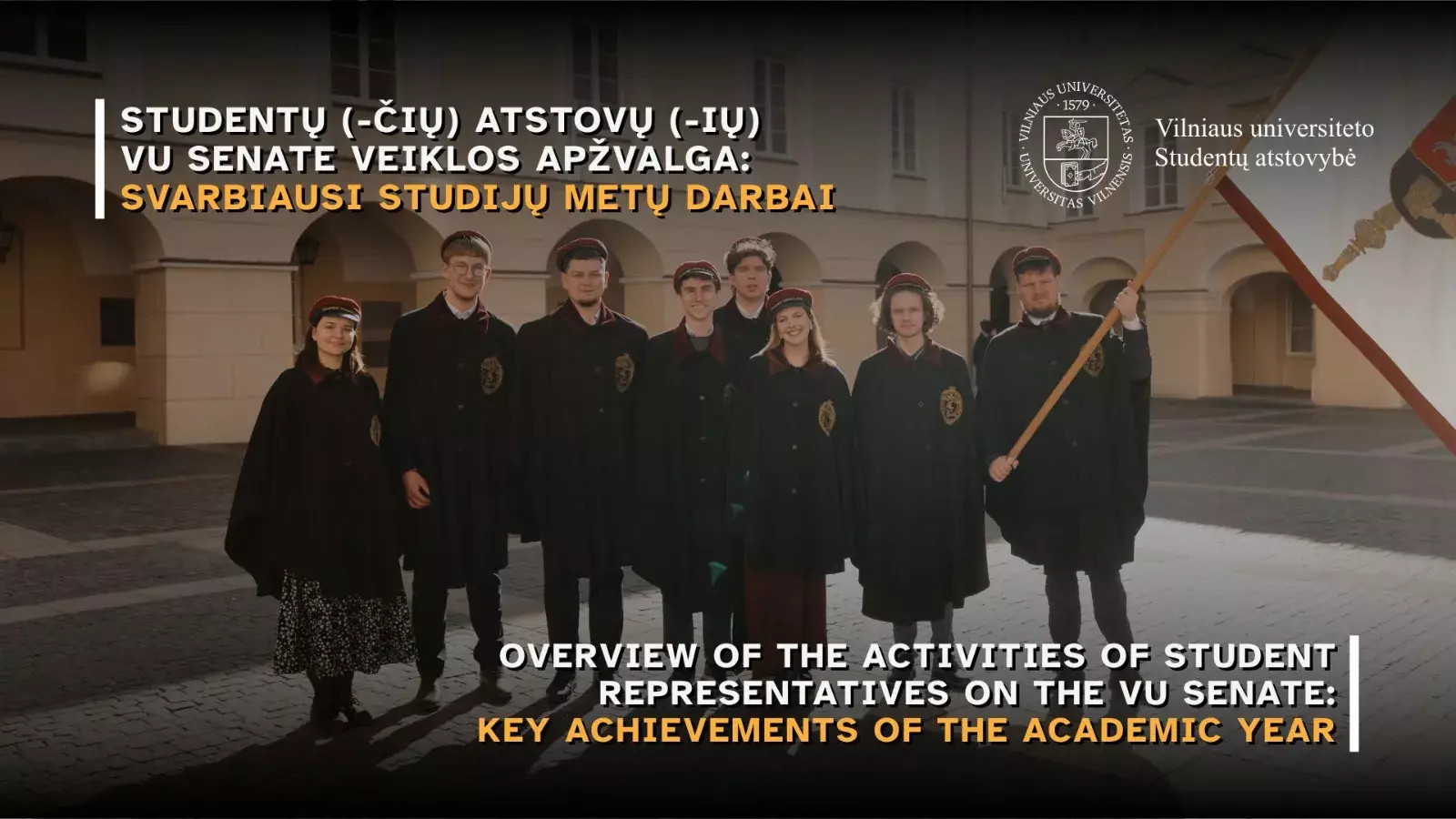
Overview of the Activities of Student Representatives on the VU Senate: Key Achievements of the Academic Year
Ugnius Bagdonavičius
Reading size
Strengthening academic ethics, giving students a greater voice in decision-making, and focusing on faculty members’ teaching competencies were the most important initiatives this year.
Strengthening academic ethics, giving students a greater voice in decision-making, and focusing on faculty members’ teaching competencies are among the most important initiatives that student representatives on the Senate of Vilnius University have contributed to this academic year.
Today, the Vilnius University community is gathering for the traditional end-of-academic-year celebration, “Finis Anni Academici.” This is not only an opportunity to celebrate achievements, but also to review the decisions that have been made to improve the quality of education and the academic environment.
During this academic year, student representatives participated in 14 Senate meetings, 7 electronic votes, the Senate’s strategic session, and the activities of committees and working groups, where some of the most important issues in the University’s academic life were discussed—ranging from the quality of studies and academic ethics to faculty competencies, doctoral programs, and the University’s strategy.
What is the Vilnius University Senate?
The Senate is the highest academic governing body at Vilnius University. It ensures freedom of culture, science, research, and teaching; it deliberates on and makes decisions regarding studies, science, and other academic matters that affect the entire university community.
The Senate consists of 46 members—the rector, faculty members, researchers, social partners, and 9 student representatives delegated by the VU Student Union.
Most of the work takes place in three Senate committees:
The Studies Committee—examines issues related to the implementation and quality of studies at Vilnius University.
The Research Committee—examines issues related to the conduct and development of research at Vilnius University.
Quality and Development Committee – monitors the functioning of the study quality assurance system and examines issues related to the allocation and development of Vilnius University’s internal resources.
These committees examine issues in detail, prepare proposals, and only then forward them to Senate meetings for final decisions. Student representatives serve on all of these committees and additional working groups, enabling them to represent students’ interests even before final decisions are made.
Academic Ethics—The Result of a Long-Term Student Initiative
One of the most important achievements this year was the drafting and approval of the Vilnius University Plan for the Prevention of Academic Ethics Violations for 2026–2028.
Back in 2021, the Vilnius University Student Representation (VU SR) adopted a position on the prevention of academic ethics violations and highlighted the need for the University to have a systematic prevention plan.
This issue was subsequently included in the Senate’s work plan, and in 2025, a special working group was formed, led by student representative Povilas Virbašius. Finally, in March of this year, the Senate approved the plan, which sets the University’s course for the next three years.
The measures outlined in the plan are not limited to reducing instances of academic dishonesty. It aims to strengthen the culture of academic ethics, increase the community’s trust in academic outcomes, clarify procedures, place greater emphasis on prevention and counseling, and address new challenges such as artificial intelligence.
Student input has become a more significant part of faculty evaluations
This year, the Senate discussed the guidelines for entering into fixed-term employment contracts with faculty members and research (or artistic) staff over the age of 65.
Student representatives sought to ensure that student feedback would be clearly incorporated into decisions regarding the renewal of such faculty members’ employment contracts.
At their initiative, Section 8.5 was amended to stipulate that decisions on contract extensions must be based on feedback surveys completed by students in the VU information system, and that the final student opinion is officially presented by the VU Student Union.
This change ensures that students’ experiences and feedback become an integral part of the decision-making process, strengthens student representation, and increases the importance of students’ voices when deciding on the continuation of faculty members’ employment.
Greater Emphasis on Faculty Members’ Pedagogical Competencies
Student representatives also actively participated in discussions regarding the regulations governing the organization of competitive selection processes and certification for faculty and research (art) staff positions at Vilnius University.
During the discussions, it was emphasized that high competence in one’s field does not necessarily mean the ability to teach effectively. Therefore, student representatives consistently raised the need to strengthen the development of pedagogical competencies and to ensure that new faculty members receive the necessary training and preparation for working with students.
This focus was also reflected in broader discussions regarding qualification requirements for faculty members—the aim was to raise the bar for pedagogical competencies among associate professors and professors and to ensure the continuous improvement of their competencies.
The newly established requirement will contribute to a more consistent preparation of new faculty members for work at the University, strengthen their teaching competencies, and encourage the use of student-centered teaching and learning methods.
Decisions That Shape the University’s Future
Throughout the year, the Senate deliberated on the University’s long-term strategic decisions.
Student representatives submitted proposals during the development of Vilnius University’s strategy and discussed indicators for strategic goals, the quality of studies, the expansion of doctoral programs, the University’s resilience, and other issues related to the future. The Senate also discussed the regulations governing core academic units, the establishment of new study programs, the quality of doctoral studies, and the model for research funding.
Student representatives on the Senate also consistently emphasized that attention must be paid not only to the creation of new study programs, but also to their quality, faculty competence, a culture of feedback, and monitoring the implementation of decisions made. It was precisely these priorities that were presented to the Senate as the most important areas that students see for the coming years.
During the 2025–2026 academic year, Vilnius University students were represented in the VU Senate by Simonas Granskas (FL), Julija Jarutytė (IIRPS), Justinas Kavoliūnas (LSC), Tadas Lekšas (FP), Emilis Mikulskis (IIRPS), Daniel Šematovič (LSC), Samanta Valiušaitytė (FPs), Povilas Virbašius (FL), and Rokas Urbonas (CHGF).


