Povilas Virbašius elected President of the ARQUS Student Council at the ARQUS Alliance Annual Conference
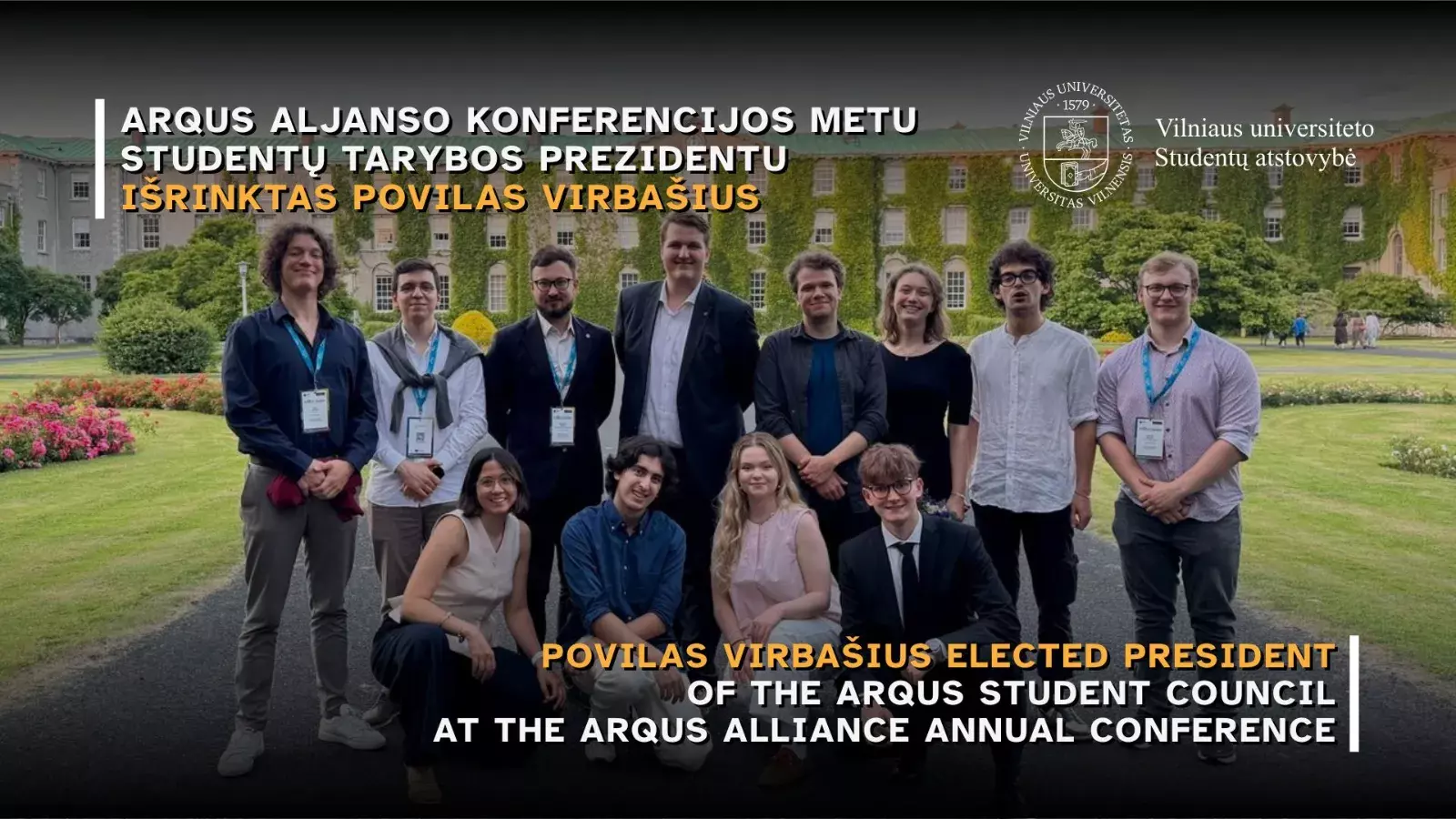
Photo by VU SA
Reading size
At the ARQUS Annual Conference, Voices of Impact: Weaving Stories Across Europe, held in Ireland on 7–9 July, Povilas Virbašius was elected President of the ARQUS Student Council.
At the ARQUS Annual Conference, Voices of Impact: Weaving Stories Across Europe, held in Ireland on 7–9 July, Povilas Virbašius was elected President of the ARQUS Student Council, becoming the second Vilnius University student to hold this position.
Together with Vilnius University Students' Representation (VU SR) President Uršulė Barkauskaitė, Povilas Virbašius serves as a member of the ARQUS Student Council, representing Vilnius University students. In his new role, he will coordinate the work of student representatives from universities across the alliance, contribute to shaping common priorities, and work to strengthen the student voice in ARQUS decision-making.
"The election of a Vilnius University student as President of the ARQUS Student Council once again demonstrates that the experience and ideas of our student representatives are recognised internationally. It is an opportunity not only to learn from other universities but also to share the good practices we have developed at Vilnius University. Although ARQUS brings together different cultures, experiences, and higher education systems, the challenges students face are often remarkably similar. I believe that by working together we can develop solutions that benefit universities across Europe," says P. Virbašius.
Personal Stories at the Heart of the Conference
This year's conference theme, Voices of Impact: Weaving Stories Across Europe, invited participants to explore the impact of European university alliances through the experiences of individuals. Across four plenary sessions held over three days, members of the academic community, university staff, students, and higher education policy experts shared stories highlighting international cooperation, inclusion, institutional transformation, and the role of universities in society.
"When discussing European university alliances, we often use broad concepts such as mobility, cooperation, or institutional transformation. Yet behind each of these ideas are people. The stories shared during the conference illustrated how international opportunities can change the lives of individual students, academics, and staff members while inspiring broader change across entire universities," says U. Barkauskaitė.
During the opening plenary session, speakers representing different groups within the university community demonstrated how connections established through the alliance have developed into new initiatives in education, research, and community wellbeing.
Subsequent sessions focused on institutional transformation, including accessibility and inclusion, joint doctoral programmes, the governance of international cooperation, and the future of European higher education. Participants also discussed how universities can move beyond responding to political decisions and instead become active contributors to shaping higher education policy.
Building New Partnerships Across Europe
The conference also provided VU SR representatives with opportunities to establish connections with representatives from other European universities, alliances, and higher education organisations. One of the most significant meetings took place with Fernando Galán, Executive Director of EU-CONEXUS and former Secretary General of ARQUS as well as former President of the European Students' Union (ESU).
VU SR representatives got valuable insights into the development of other European university alliances and provided an opportunity to discuss potential future cooperation. Discussions also explored closer collaboration with the European Students' Union and the possibility of organising student representative training programmes in Brussels.
"Speaking with people who have contributed to European higher education policy from different perspectives helps us better understand where we stand and what opportunities lie ahead. Our discussion was particularly valuable, as connections like these can lead to tangible opportunities for our student representatives to strengthen their competences and gain a deeper understanding of European decision-making processes," says U. Barkauskaitė.
According to her, such meetings are also important in encouraging Vilnius University student representatives to become more actively involved in international student movements and discussions shaping the future of European higher education.
European Commission to Fund the Next Stage of ARQUS Development
During the conference, it was also announced that the European Commission will fund the implementation of the Arqus Bridge project for the 2026–2028 period. The project marks the next phase of ARQUS development, focusing on strengthening institutional integration among alliance universities, expanding joint study programmes, research and innovation activities, and creating more opportunities for students, researchers, and university staff.
The new project builds upon the updated ARQUS 2026–2035 Long-Term Strategy adopted earlier this year. Its key priorities include climate change and sustainable development, responsible artificial intelligence and digital transformation, and strengthening Europe's role in the world.
Arqus Bridge will also support the development of shared governance, digital, and quality assurance systems, promote more flexible European learning opportunities, and reinforce the alliance's commitment to inclusion, multilingualism, and sustainability.
"The funding of this new project demonstrates that ARQUS is entering a more mature stage of cooperation. For students, it is important that institutional agreements and strategic ambitions translate into tangible opportunities—joint study programmes, mobility, research activities, and meaningful participation in shaping the future of the alliance," says P. Virbašius.
The ARQUS Student Council is the official student representative body of the ARQUS Alliance, bringing together student representatives from all member universities. The Council ensures that students' perspectives are reflected in decisions concerning the alliance's activities and future development. Its members also develop joint initiatives, exchange best practices between universities, and strengthen cooperation across the ARQUS community.


