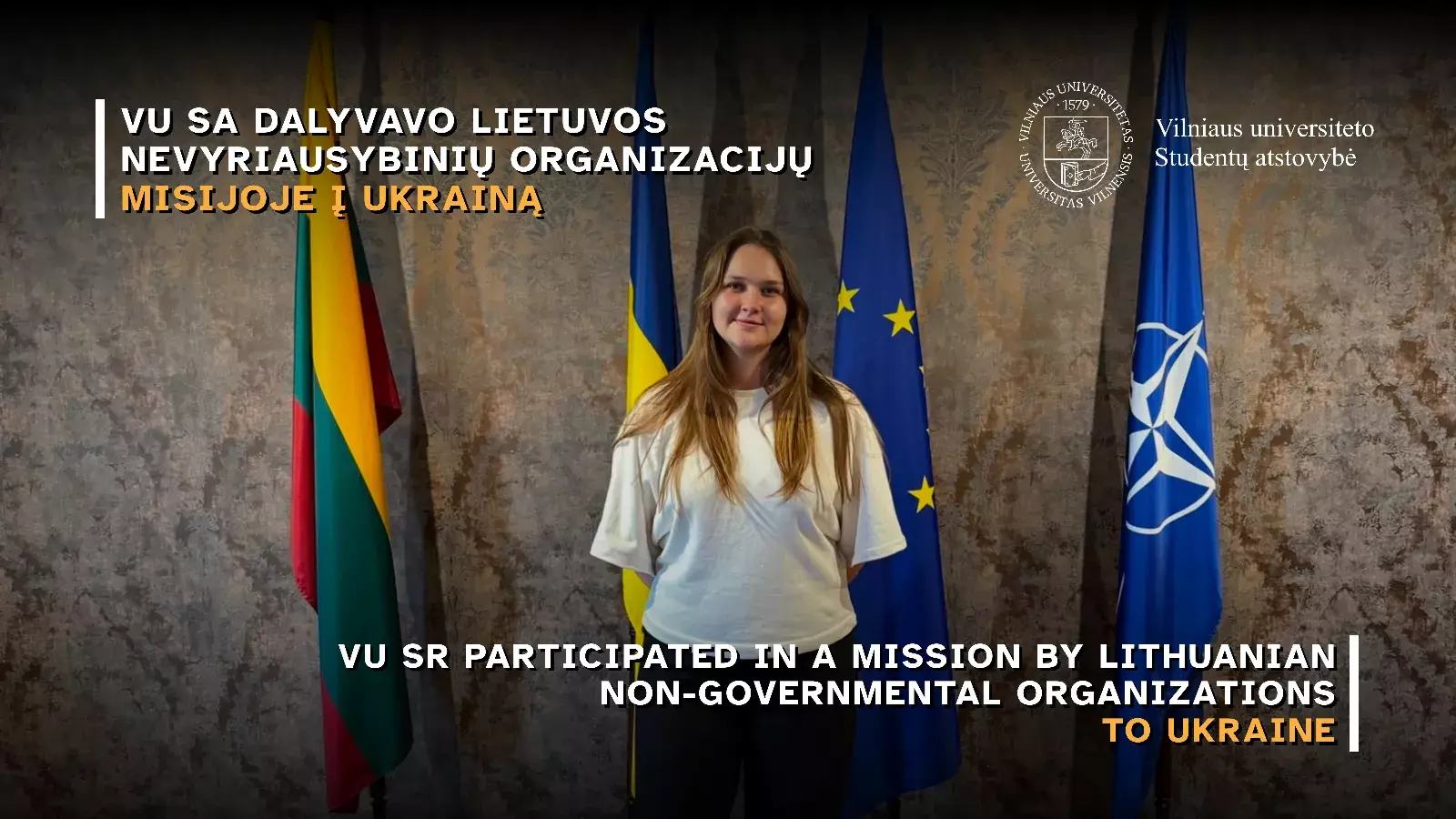
VU SR Participated in a Mission by Lithuanian Non-Governmental Organizations to Ukraine
Reading size
From May 24 to 27, a mission of Lithuanian non-governmental organisations (NGOs) to Ukraine took place in the Kyiv region to strengthen long-term partnerships.
From May 24 to 27, a mission of Lithuanian non-governmental organisations (NGOs) to Ukraine took place in the Kyiv region to strengthen long-term partnerships between Lithuanian and Ukrainian civil society organisations and explore ways to contribute to Ukraine’s resilience and recovery efforts.
Rūta Šakickaitė, Coordinator of International Student Affairs at the Vilnius University Student Representation (VU SR), also participated in the mission. During the visit, she met not only with representatives of Ukrainian non-governmental organisations and institutions, but also with the Student Council of Taras Shevchenko National University of Kyiv.
According to R. Šakickaitė, this experience allowed her to see firsthand how university communities are living today in a country where war has become part of everyday life.
“Life here doesn’t stop”
The mission began shortly after one of the largest Russian attacks on Ukraine in recent times. On Sunday night, Russian forces launched large-scale missile and drone strikes on Kyiv and surrounding regions.
Despite the difficult situation, a delegation of Lithuanian organisations left for Ukraine the very next morning. According to R. Šakickaitė, it was this experience that gave her an even deeper understanding of Ukrainians’ daily lives and the resilience of their society.
“Upon arrival, I realised that even after such attacks, life here doesn’t stop. People work, help one another and others, create initiatives, and seek solutions. That ability to maintain hope even under such circumstances left a very strong impression,” she says.
Universities Adapt to the Reality of War
During a meeting with the Student Council of Taras Shevchenko National University of Kyiv, there was much discussion about how universities are currently organising daily life under wartime conditions.
According to Rūta Šakickaitė, Ukrainian universities place a strong emphasis on safety.
“Paths to shelters are specially marked for students at the university so that in a crisis, it is clear where to go. Some basements have been adapted so that people can spend more time there—there are benches and places to sit,” she explains.
According to her, much of the university infrastructure remained unrenovated or neglected during the war due to constant threats and limited resources. However, even under such circumstances, university communities strive to maintain student life.
“There was a strong sense of community—the university campus is full of students, people are spending time outdoors, playing sports, and meeting in cafés. It was strange to see such vitality knowing the conditions they live in,” says R. Šakickaitė.
During the visit, she also had the opportunity to observe the Student Council elections.
“It was interesting to see that even under wartime conditions, student self-governance remains active, elections are held, and people engage in community life. This reminded me once again how important the voice and sense of community among students are, even under the most difficult circumstances,” she shares.
Lessons Lithuania Can Learn From
According to Rūta Šakickaitė, this experience has offered a new perspective on crisis preparedness in Lithuania.
“When talking with students, I realised that, until the full-scale invasion, many of them didn’t believe that war could actually break out. Because of this, we had to learn quite a few things during the crisis itself. It seems to me that in Lithuania we talk more about preparedness, and that is very important,” she says.
According to R. Šakickaitė, Ukraine’s experience shows that resilience begins with the community.
“It’s not just about shelters or infrastructure. It’s about people’s readiness to care for one another and the understanding that during a crisis, no one should be left behind,” she states.
The project was organised by the Ministry of Foreign Affairs of the Republic of Lithuania, the Lithuanian Centre for International Partnerships, and the Embassy of the Republic of Lithuania in Ukraine.


